DATA STRUCTURE AND ALGORITHM (Pointer)
POINTER
datatype *var_name;
int *ptr;   //ptr can point to an address which holds int data
How to use a pointer?
- Define a pointer variable
- Assigning the address of a variable to a pointer using unary operator (&) which returns the address of that variable.
- Accessing the value stored in the address using unary operator (*) which returns the value of the variable located at the address specified by its operand.
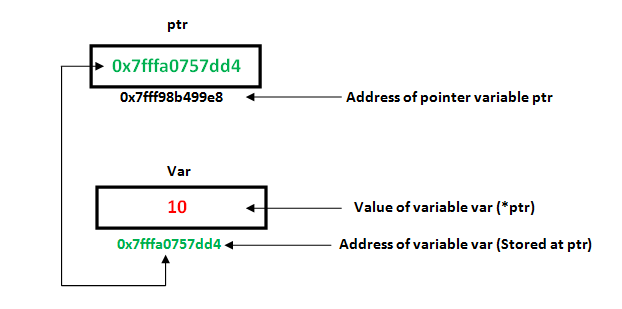
C++ program to illustrate Pointers in C++
#include <iostream>
using namespace std;
void pointer()
{
int var = 20;
int *ptr; //declare pointer variable
//note that data type of ptr and var must be same
ptr = &var;
// assign the address of a variable to a pointer
cout << "Value at ptr = " << ptr << "\n";
cout << "Value at var = " << var << "\n";
cout << "Value at *ptr = " << *ptr << "\n";
}
//Driver program
int main()
{
pointer();
}
Value at ptr = 5c7fffdd95ggg
Value at var = 20
Value at *ptr = 20
Pointer Expressions and Pointer Arithmetic
A limited set of arithmetic operations can be performed on pointers which are:
- incremented ( ++ )
- decremented ( — )
- an integer may be added to a pointer ( + or += )
- an integer may be subtracted from a pointer ( – or -= )
- difference between two pointers (p1-p2)
(Note: Pointer arithmetic is meaningless unless performed on an array.)
C++ program to illustrate Pointer Arithmetic in C++
#include <iostream>
using namespace std;
void pointer()
{
//Declare an array
int v[3] = {10, 100, 200};
//declare pointer variable
int *ptr;
//Assign the address of v[0] to ptr
ptr = v;
for (int i = 0; i < 3; i++)
{
cout << "Value at ptr = " << ptr << "\n";
cout << "Value at *ptr = " << *ptr << "\n";
// Increment pointer ptr by 1
ptr++;
}
}
//Driver program
int main()
{
pointer();
}
Output:Value at ptr = 0x7fff9a9e7920
Value at *ptr = 10
Value at ptr = 0x7fff9a9e7924
Value at *ptr = 100
Value at ptr = 0x7fff9a9e7928
Value at *ptr = 200

Invalid pointers
A pointer should point to a valid address but not necessarily to valid elements (like for arrays). These are called invalid pointers. Uninitialized pointers are also invalid pointers.
int *ptr1;
int arr[10];
int *ptr2 = arr+20;
Here, ptr1 is uninitialized so it becomes an invalid pointer and ptr2 is out of bounds of arr so it also becomes an invalid pointer.
(Note: invalid pointers do not necessarily raise compile errors)
NULL Pointers
Null pointer is a pointer which point nowhere and not just an invalid address.
Following are 2 methods to assign a pointer as NULL;
int *ptr1 = 0;
int *ptr2 = NULL;


Comments
Post a Comment